American Civil War · Eastern Theater
Pickett's Charge
3 July 1863 — the high-water mark of the Confederacy
“The guns have gone quiet, and now there is nothing between us and that ridge but Pennsylvania farmland baking in the July sun. General Pickett rides past and says, simply, that it is time.”
This happened 143 years before you were born — 163 years ago.
Why it mattered
By the morning of July 3, 1863, Robert E. Lee's Army of Northern Virginia had been fighting outside the Pennsylvania town of Gettysburg for two days. The Confederate left had failed to take Little Round Top; the right had been repulsed from Culp's Hill. Lee turned to the Union center — Cemetery Ridge — held by Maj. Gen. George Meade's Army of the Potomac behind a low stone wall. He ordered a frontal assault by roughly 12,500 infantry drawn from three divisions under Maj. Gen. George Pickett, Brig. Gen. James Pettigrew, and Maj. Gen. Isaac Trimble. Pickett commanded only one of the three divisions — his Virginians were perhaps a third of the force.
If the Confederate infantry could shatter the Union center, they might split Meade's army and open a path toward Washington — forcing a peace that could win the Confederacy its independence. Failure here, Lee's generals quietly understood, would likely end any hope of a decisive Northern invasion and with it, any prospect of European recognition.
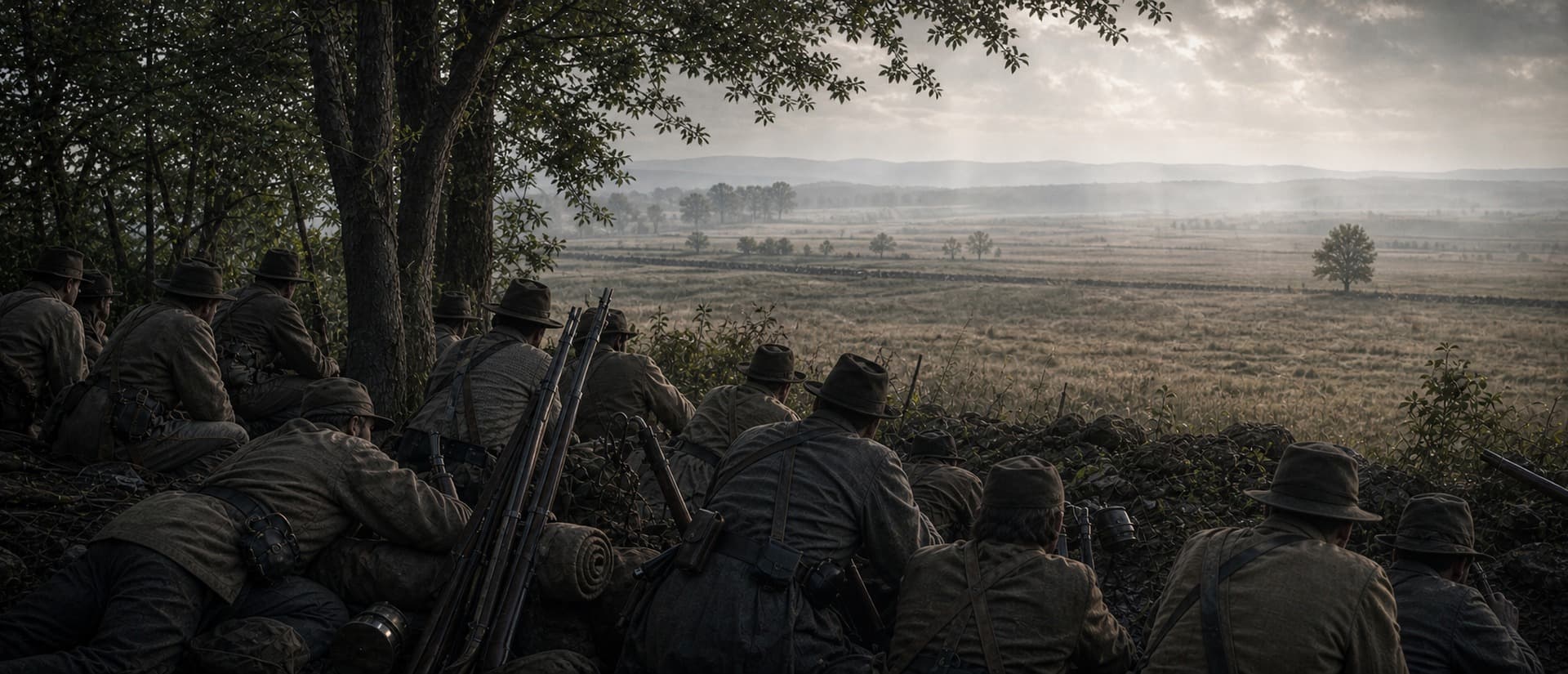
We have lain in the tree line since morning, sweat soaking our wool jackets. The fields ahead are quiet and very wide. Somewhere across them are the Yankees — fifty thousand, the men say.
Morning of July 3, 1863 — Confederate infantry wait in the tree line west of the open ground.
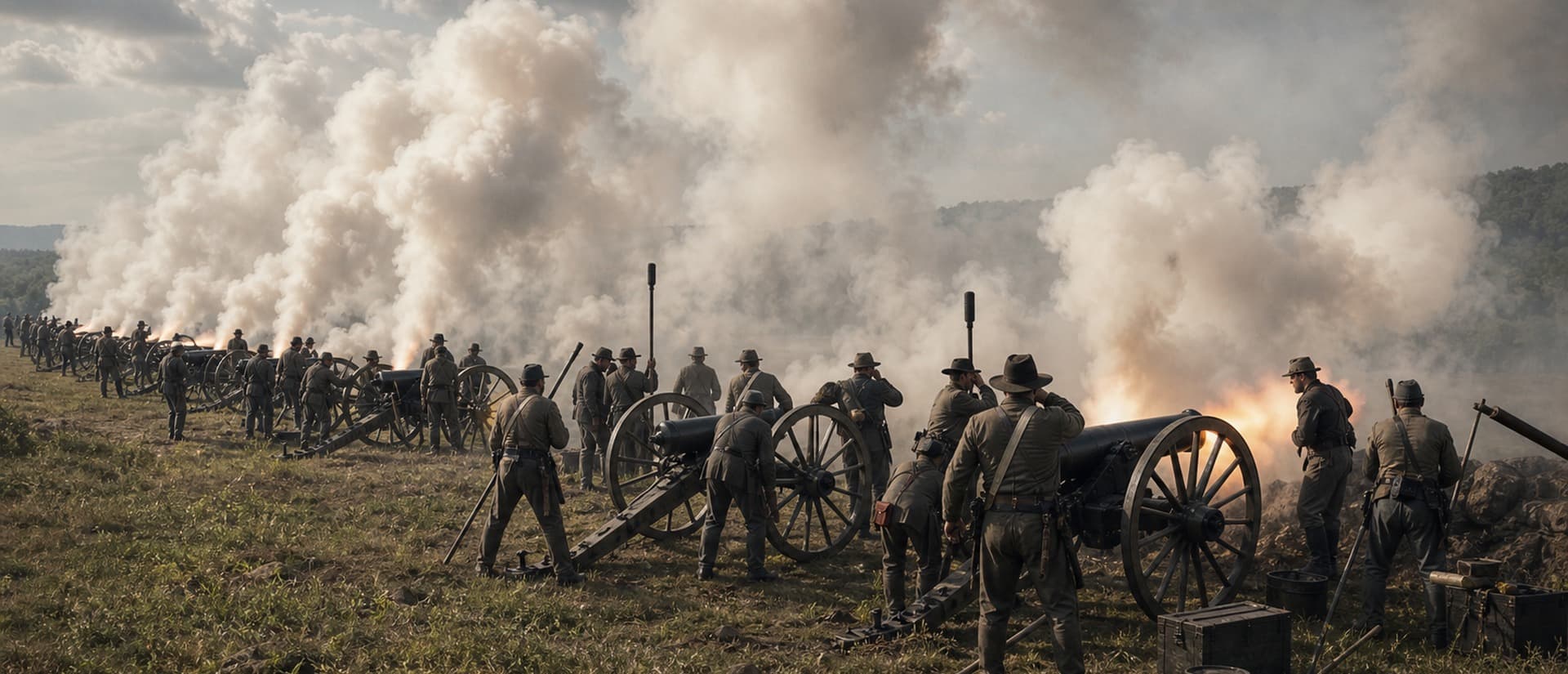
At one o'clock our artillery opens — a hundred and fifty guns at once, a roar so total men clap their hands over their ears. Then silence. And General Pickett says the word: Forward.
~1:00–3:00 p.m. — a ~150-gun barrage that largely overshot the ridge; then, in the silence, the order to advance.
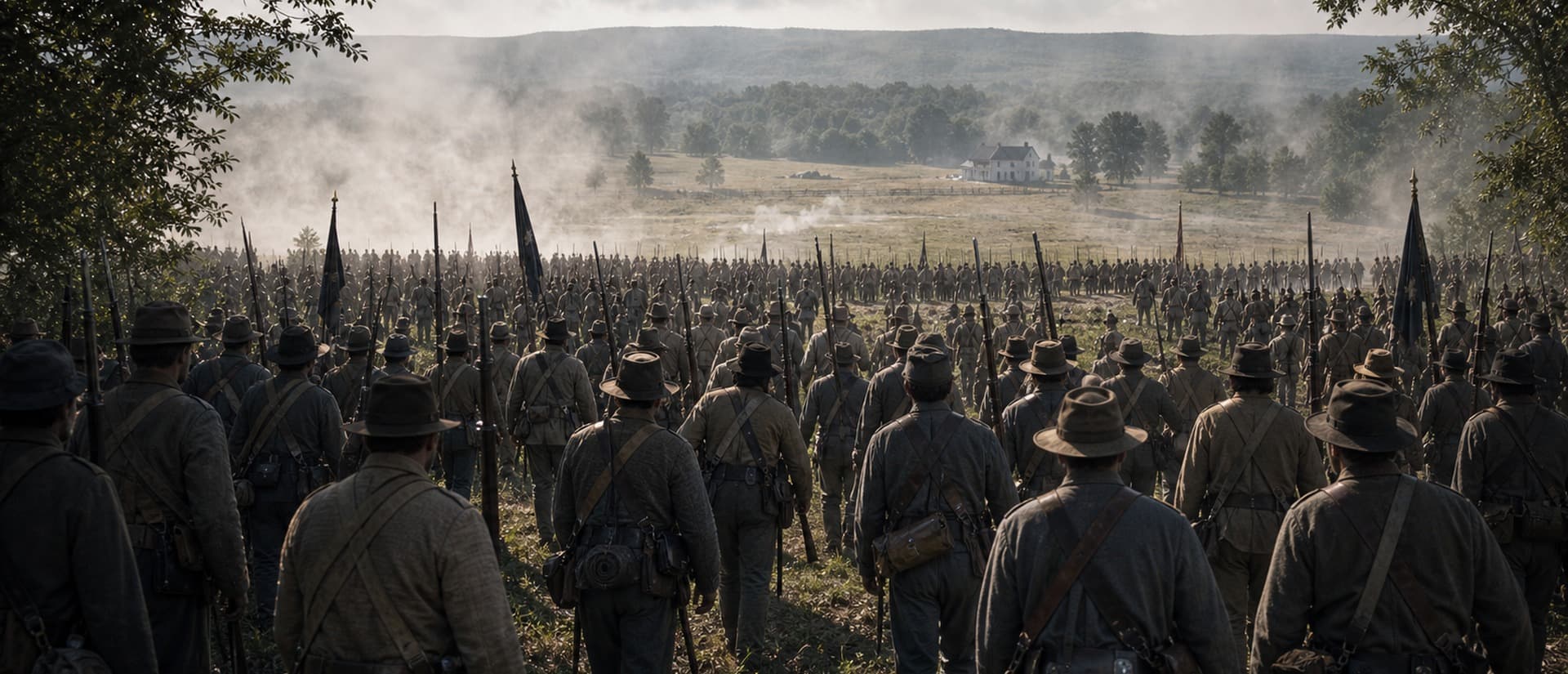
We step into the sun and the whole world opens — a mile of Pennsylvania farmland, and beyond it the long dark line of Cemetery Ridge. Twelve thousand men dress their lines. Then the Union guns begin again.
~12,500 Confederate infantry step off across roughly three-quarters of a mile of open ground toward Cemetery Ridge.
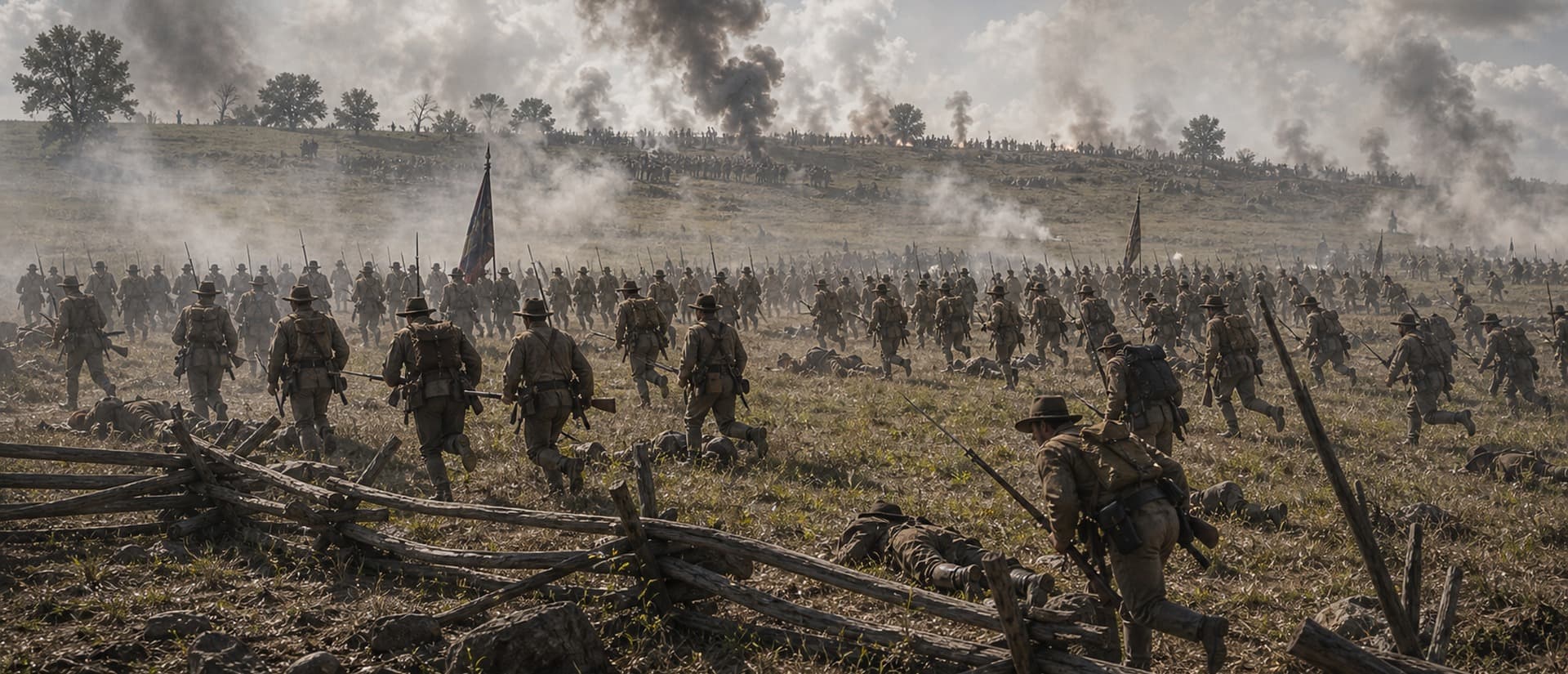
The solid shot comes first — iron balls skipping through the ranks like stones across water. A man three files to my left simply ceases to exist, in a red mist. We are taught not to look, and to keep moving.
Union artillery fired solid shot, then shell, then finally canister as the range closed — each round tore gaps in the advancing lines.
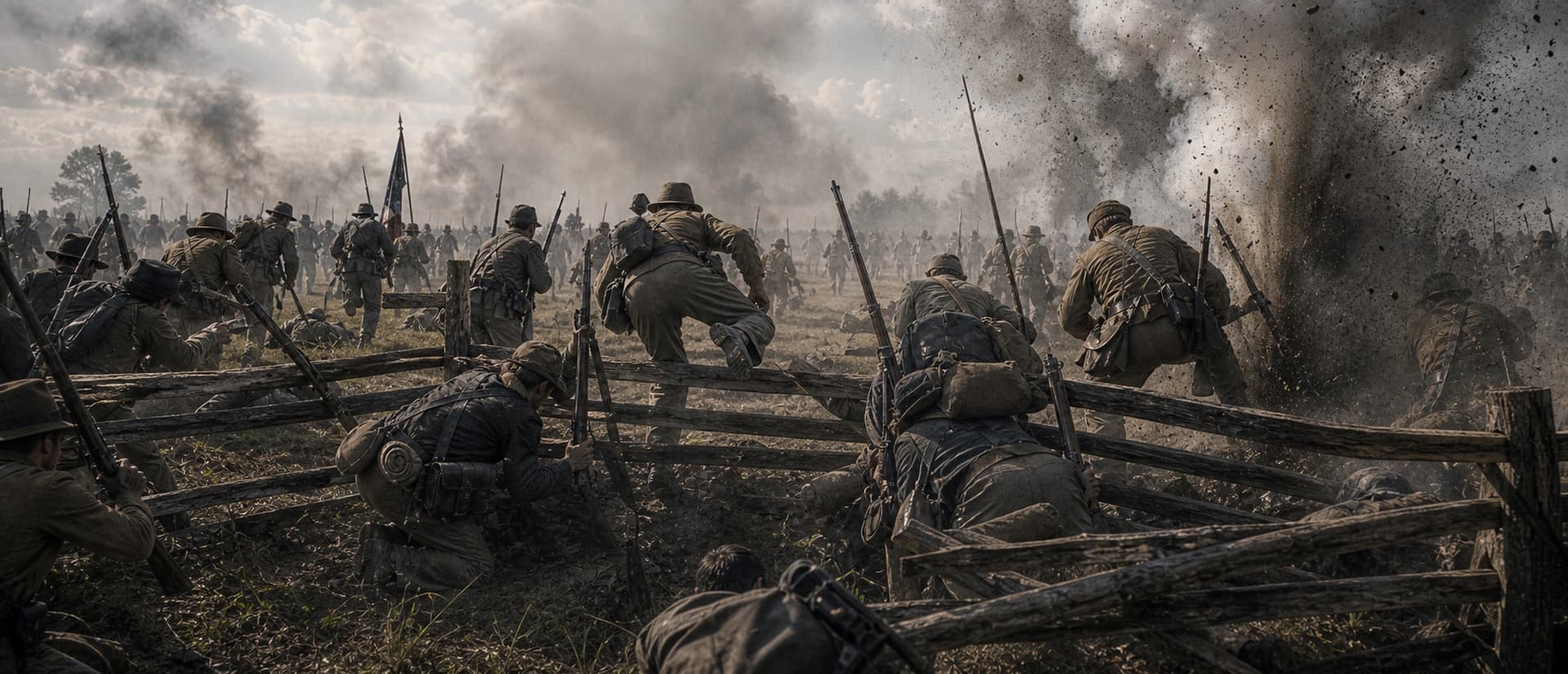
The Emmitsburg Road. To cross the fences we must stop and climb — and this is where the canister finds us, a cannon turned into a giant shotgun. We lose hundreds in seconds. The men who reach the far side run.
The Emmitsburg Road fences forced the attackers to stop and climb — under devastating canister fire from Union artillery at close range.
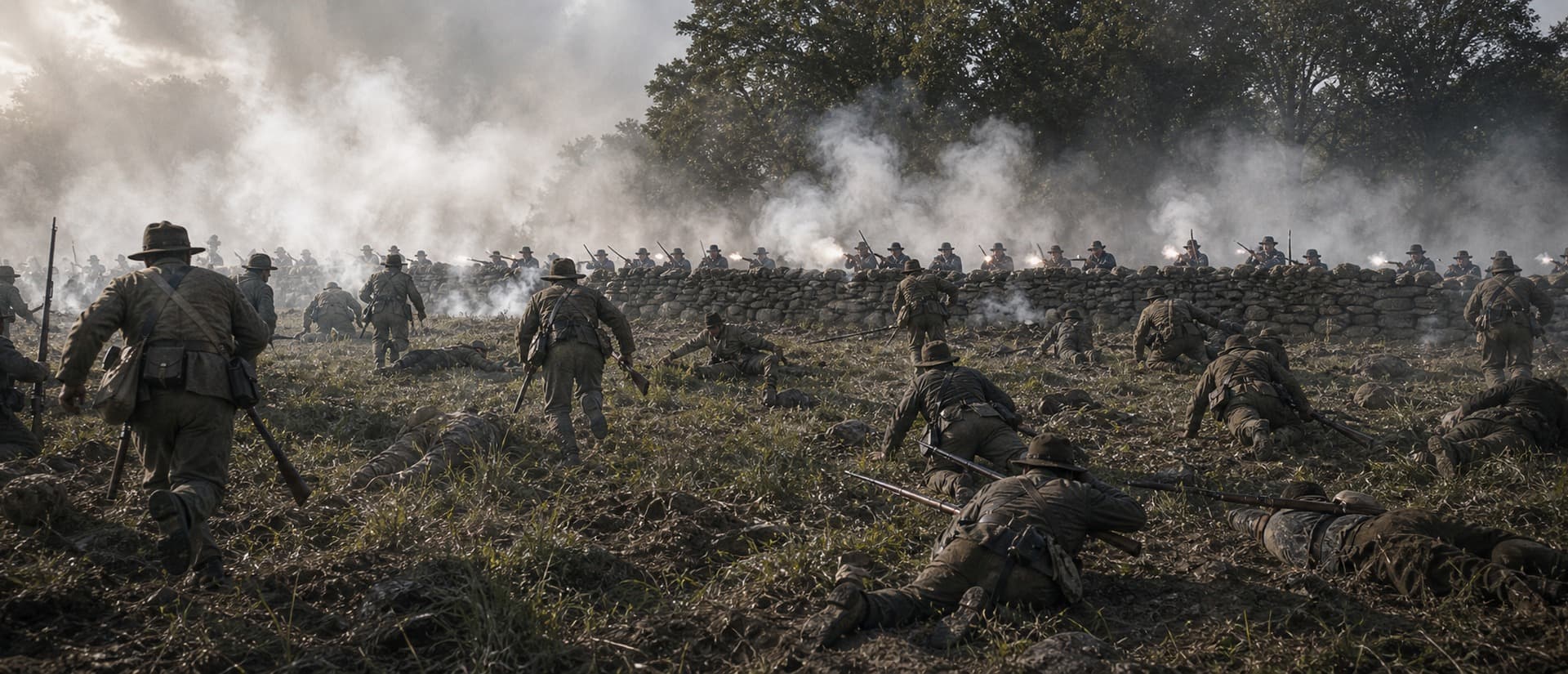
Now the wall itself is breathing fire — low Pennsylvania fieldstone, Union infantry pouring volleys into us. I am shouting the Rebel yell, though I could not say what. The wall is still two hundred yards away.
Union infantry behind the stone wall on Cemetery Ridge delivered sustained musket fire as the Confederates crossed the final stretch.
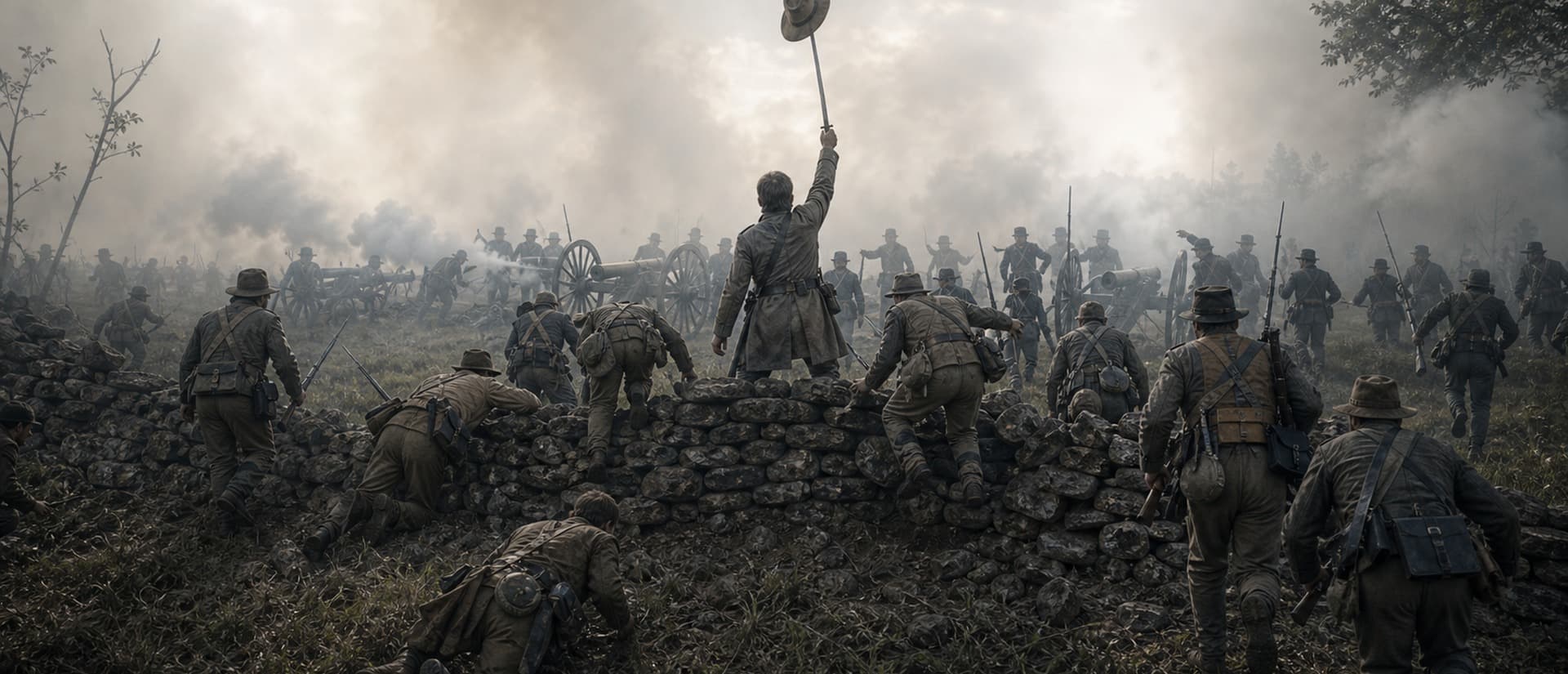
Armistead is just ahead, his hat on his sword tip so we can find him in the smoke. He clears the wall — one of the very few — and for a moment we stand on the Union side. The farthest we will ever get.
Brig. Gen. Lewis Armistead led a small breach at 'the Angle' in the stone wall — the deepest Confederate penetration of the Union line.
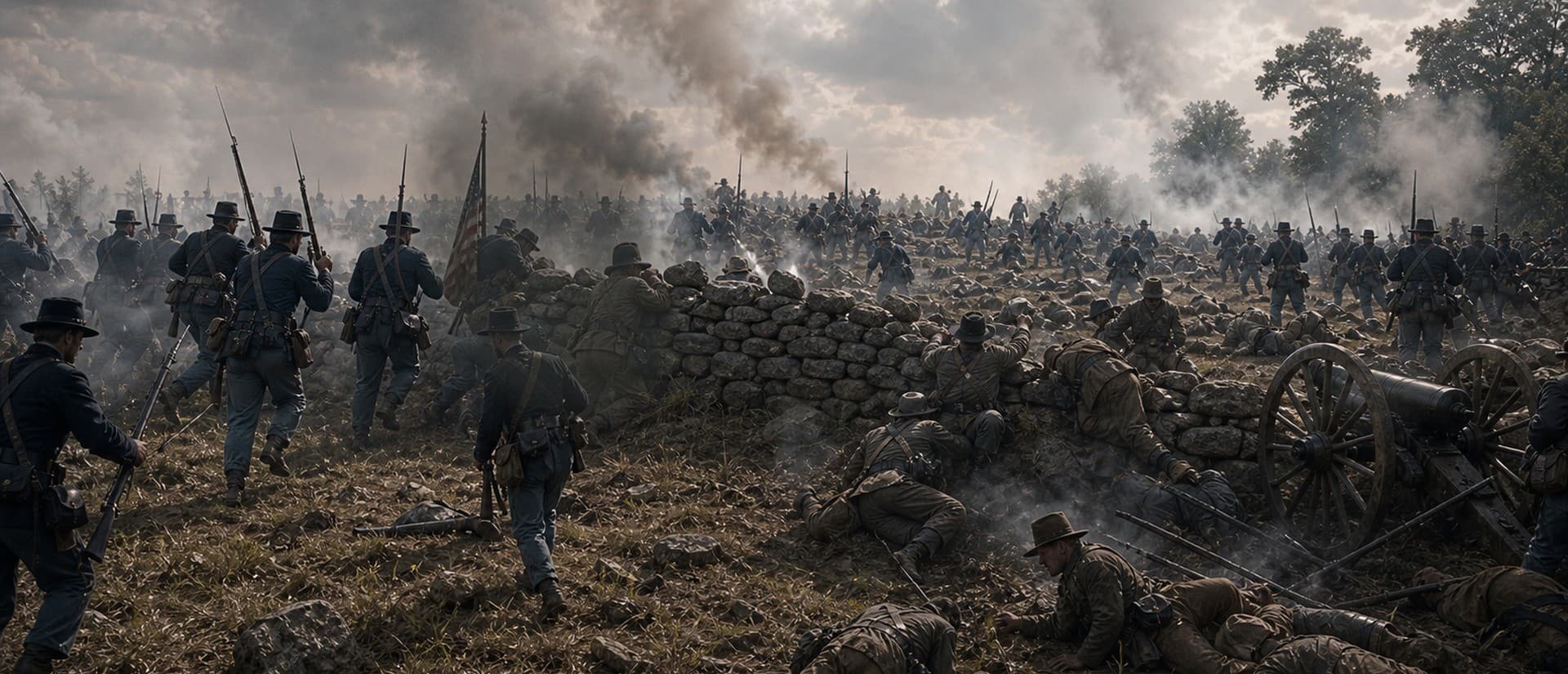
It lasts perhaps a minute. Union reserves flood in from three sides; Armistead goes down beside a cannon he will never live to see taken. The men around me break. The wall belongs to the Union, as it always did.
The breach at the Angle lasted only minutes. Union reserves counterattacked from three sides; Armistead was mortally wounded beside a Union cannon.
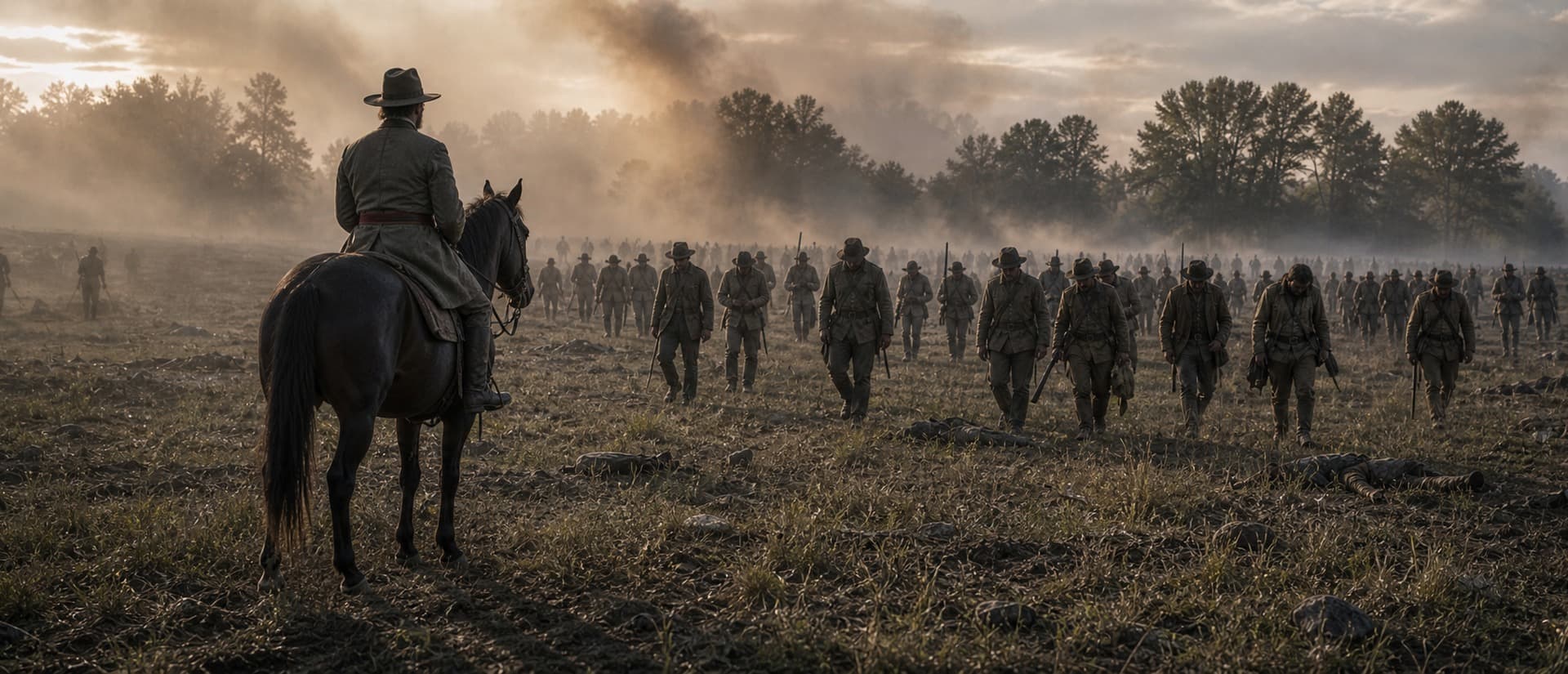
The walk back is worse than the advance. We are no longer an army — just men, bleeding across the same ground that tore us apart an hour ago. Lee rides out to meet us, very straight in the saddle, his face a mask.
“It is all my fault.”
The shattered force retreated; Lee met the survivors, reportedly saying 'It is all my fault.' Estimated Confederate casualties: more than 6,000 of ~12,500 engaged.
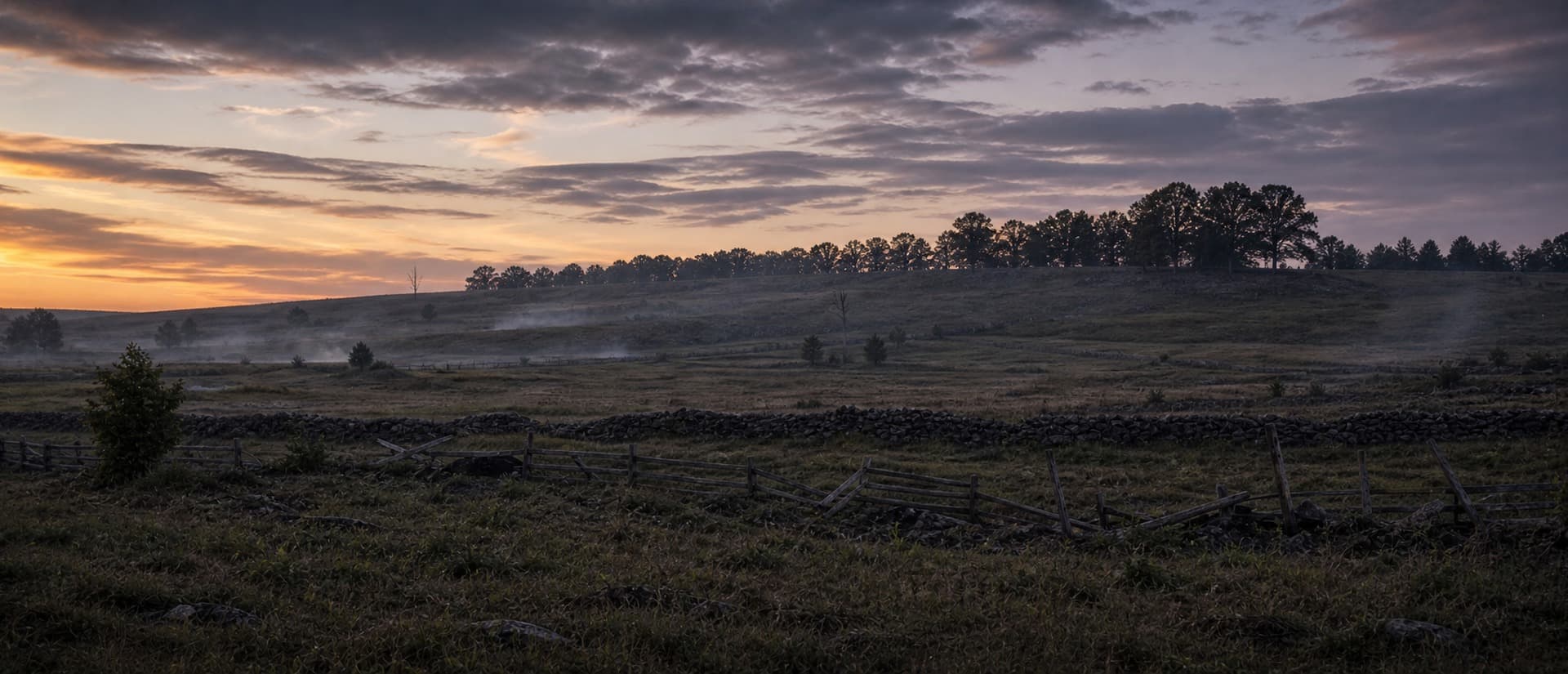
The next day, Vicksburg falls to Grant. Lee will never invade the North again. I am alive — I do not yet know what that means. I only know the copse of trees still stands on Cemetery Ridge, and we do not.
July 4, 1863: Vicksburg surrendered to Grant. Together, Gettysburg and Vicksburg mark the decisive turning point of the American Civil War. 3 July 1863 was 163 years ago — within about two long lifetimes of now.
Look closer
Objects, maps, and small visual clues that make the story easier to read.
What it changed
Lee's Army of Northern Virginia retreated to Virginia in heavy rain beginning July 4–5, 1863, never again to invade the North. The simultaneous surrender of Vicksburg to Ulysses S. Grant on July 4 gave the Union control of the Mississippi River, cutting the Confederacy in two. Though the war would continue for nearly two more years — until Appomattox in April 1865 — the strategic initiative had permanently shifted to the Union, and any serious prospect of European diplomatic recognition for the Confederacy was gone. The site of the Angle is today a centerpiece of Gettysburg National Military Park.
July 3, 1863
This happened 143 years before you were born — 163 years ago.
Pickett's Charge happened 163 years ago — within about two long lifetimes of today. The last Union veteran, Albert Woolson, died in 1956; the last accepted Confederate veteran, Pleasant Crump, in 1951. (EDITORIAL: verify last-veteran dates before publish.)
What to remember
The essentials — the kind of thing that shows up on the exam.
- 1July 3, 1863: Confederate General Robert E. Lee ordered a massive frontal assault on the Union center at Cemetery Ridge on the third and final day of the Battle of Gettysburg.
- 2About 12,500 Confederate infantry under Pickett, Pettigrew, and Trimble advanced roughly three-quarters of a mile across open farmland under devastating Union artillery and musket fire; a small force briefly breached the Union line at 'the Angle' before being repulsed.
- 3Confederate casualties exceeded 50% — an estimated 6,000+ men killed, wounded, or captured out of ~12,500; Brig. Gen. Lewis Armistead, who led the breach, was mortally wounded at the stone wall.
- 4The failure of Pickett's Charge, with the fall of Vicksburg on July 4, 1863, marked the decisive turning point of the Civil War: Lee never invaded the North again, and the Confederacy never recovered its offensive capacity.
- 5Gettysburg is central to the APUSH curriculum as the Union's clearest turning-point victory and the battle that ended Confederate hopes of winning the war through invasion of the North.
Keep going
Read another story
More immersive history stories are unlocked now, with anniversary dates used for promotion.
Sources
- Gettysburg — Stephen W. Sears
- The Gettysburg Campaign: A Study in Command — Edwin B. Coddington
- Battle Cry of Freedom: The Civil War Era — James M. McPherson
- Gettysburg National Military Park (official battlefield resources) — U.S. National Park Service
As an Amazon Associate, OlderThan earns from qualifying purchases.