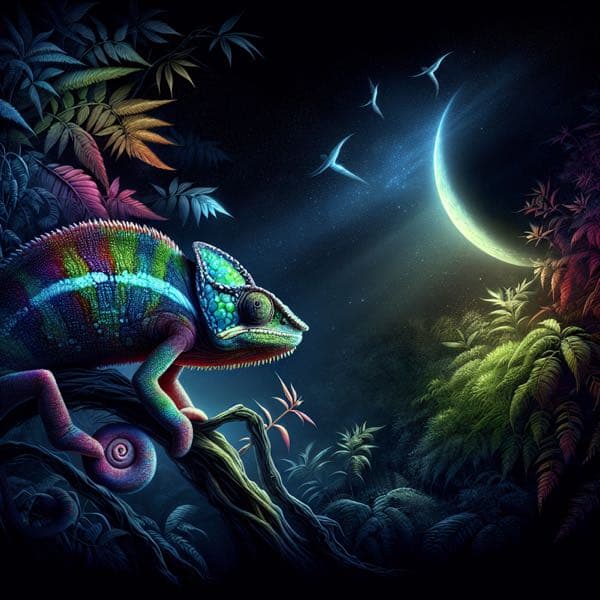
Chameleon
Changes color to match its surroundings. At 5, you're doing the same thing — figuring out how to fit in.
Changes color to match its surroundings. At 5, you're doing the same thing — figuring out how to fit in.
Lifespan
5 years
Your age
20
Height
Up to 1 ft long
Habitat
Africa, Madagascar, parts of Europe and Asia
Are you older than a Chameleon?
Yes — you are 15 years older than a typical Chameleon's entire lifespan of 5 years.
At your age (20), you've already outlived a typical Chameleon by 15 years. The last milestone in a Chameleon's life is at age 5: final year of life.
In 2006, when you were born
Population
4,740,000
Still alive today
4
Population trend
➡️ Stable
Current population
5,000,000
Conservation status
Least ConcernChameleon Life Timeline
Chameleons are nature's little shape-shifters, capable of changing their colors faster than you can say 'What color am I today?' This dazzling ability serves as a form of communication and camouflage, making them the ultimate social media influencers of the reptile world. With their bulging eyes that can move independently, they can spot a tasty insect from a distance while simultaneously keeping an eye on potential threats. Talk about multitasking!
Read more
These fascinating reptiles have a relatively short lifespan of about five years in the wild, during which they go through various life stages, from a hatchling no bigger than a pencil to a full-grown adult that can reach up to a foot long. They thrive in warm, tropical habitats, mostly in Africa and Madagascar, where they can blend in with the vibrant foliage. Chameleons are solitary creatures, preferring to spend their days basking in the sun or lurking among the leaves, waiting for their next meal — which is usually a hapless insect that doesn't see their lightning-fast tongue coming!
Chameleons play a crucial role in their ecosystems as insectivores, helping to control insect populations. While they may not have a direct relationship with humans, their mesmerizing color-changing abilities have made them popular pets and symbols of adaptability. Just remember, while you're contemplating your next outfit, this little reptile has already perfected the art of disguise!
Hatched from an egg
Chameleons begin their lives as tiny hatchlings, emerging from eggs laid in the ground. These little guys are ready to face the world, albeit with a lot of growing up to do!
A chameleon hatches from its egg at just 0 months old. At that age, most humans are a newborn. Are you older than a chameleon when it hatches from its egg?
And they're off! The chameleon comes out of the gate — hatched from an egg. The human at 0 months? Can't even hold their own head up. Not even close.
Learning to change colors
By six months, baby chameleons start to master the art of color change, experimenting with shades to match their environment and communicate with others. It’s like a toddler discovering their favorite crayon!
A chameleon is learning to change colors at just 6 months old. At that age, most humans are learning to crawl. Are you older than a chameleon when it is learning to change colors?
Look at this chameleon go! Learning to change colors. Meanwhile the human at 6 months is learning to crawl and babble. The chameleon is lapping the competition.
First successful hunt
At one year old, chameleons become proficient hunters, using their long tongues to catch insects. It’s their version of a first birthday party — but with a lot more protein!
A chameleon reaches its first successful hunt by age 1. At that age, most humans are a wobbly toddler. Are you older than a chameleon when it reaches its first successful hunt?
Look at this chameleon go! First successful hunt. Meanwhile the human at age 1 is a wobbly toddler still figuring out walking. The chameleon is lapping the competition.
Reaching sexual maturity
By two years, chameleons are ready to mingle! They’ve reached sexual maturity and are on the lookout for a mate, flaunting their colors to attract partners. It’s like a high school dance but with more scales.
A chameleon reaches its reaching sexual maturity stage by age 2. At that age, most humans are a toddler in diapers. Are you older than a chameleon when it reaches its reaching sexual maturity stage?
Reaching sexual maturity for the chameleon! Meanwhile the human at this age is still in diapers, throwing tantrums over spoons. The chameleon is living life on fast-forward.
Mastering camouflage
At three years old, chameleons have perfected their camouflage skills, blending into their surroundings like a pro. They can change colors to match leaves, branches, or even the occasional fashion statement!
A chameleon reaches its mastering camouflage stage by age 3. At that age, most humans are in preschool. Are you older than a chameleon when it reaches its mastering camouflage stage?
The chameleon is at full power — mastering camouflage. The human at age 3? Is in preschool, learning to share and asking "why" 400 times a day. Two very different versions of peak performance.
Establishing territory
By four, chameleons start to establish their own territories, marking their space with color displays and posturing. It’s like putting up a 'No Trespassing' sign, but way more colorful!
A chameleon reaches its establishing territory stage by age 4. At that age, most humans are in pre-K. Are you older than a chameleon when it reaches its establishing territory stage?
The chameleon is starting to ease up — establishing territory. But the human at age 4? Is in pre-K, learning to count and playing pretend. The tables are turning.
Final year of life
In their final year, chameleons focus on reproduction, ensuring their genes are passed on before heading into the great beyond. It’s a bittersweet farewell to a life lived in vibrant colors.
A chameleon reaches its final year of life stage by age 5. At that age, most humans are starting kindergarten. Are you older than a chameleon when it reaches its final year of life stage?
Final year of life. The chameleon's incredible race is complete. A human at age 5 is starting kindergarten and losing their first tooth. Short race, big life.
First offspring born
By age 6, a chameleon's lineage has produced roughly 6 generations of descendants. With a generation time of about 1 year, that's roughly 6 generations — dozens of descendants carrying on the family legacy.
A chameleon reaches its first offspring born by age 6. At that age, most humans are in elementary school. Are you older than a chameleon when it reaches its first offspring born?
Long after the finish line: first offspring born. A human at this age is in elementary school, learning to ride a bike. The chameleon's story lives on through its descendants.
Grandchildren hatching
By age 8, a chameleon's lineage has produced roughly 8 generations of descendants. With a generation time of about 1 year, that's roughly 8 generations — dozens of descendants carrying on the family legacy.
A chameleon reaches its grandchildren hatching stage by age 8. At that age, most humans are in elementary school. Are you older than a chameleon when it reaches its grandchildren hatching stage?
Grandchildren hatching — proof that this chameleon's impact didn't end at the finish line. A human at age 8 is in elementary school, memorizing multiplication tables. Legacy is the longest race of all.
Population growth observed
By age 10, a chameleon's lineage has produced roughly 10 generations of descendants. With a generation time of about 1 year, that's roughly 10 generations — dozens of descendants carrying on the family legacy.
A chameleon reaches its population growth observed stage by age 10. At that age, most humans are a pre-teen. Are you older than a chameleon when it reaches its population growth observed stage?
Long after the finish line: population growth observed. A human at this age is a pre-teen begging for a phone and staying up too late. The chameleon's story lives on through its descendants.
Lifespan Comparison
A human can outlive this species by about 75 years.
You've already outlived a Chameleon by 15 years.
See what else you're older than