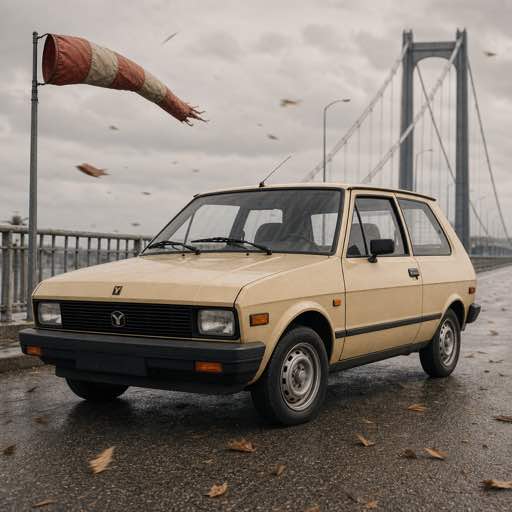
Yugo GV
It's from 1985, before you were born.
- Iconic generation
- 1985 Yugo GV (U.S. launch)
- Origin
- Kragujevac, Yugoslavia (Zastava)
- Engine
- 1.1L inline-four (carbureted)
- Power
- ~55 hp
- Body style
- Two-door subcompact hatchback
- Based on
- Fiat 127 / 128 (license-built)
- Price when new
- $3,990 (1985)
- U.S. sales
- 1985-1992 (~141,000 total)
About
As of 2026, it's 41 years old.
The Yugo GV holds a special place in American automotive folklore as the punchline that drove itself onto our shores. Imported starting in 1985 by entrepreneur Malcolm Bricklin, it was a license-built Fiat clone made in Yugoslavia, and its entire pitch was a single, irresistible number: $3,990, the cheapest new car in America.
The 'GV' supposedly stood for 'Great Value,' and for $3,990 you got exactly what that money buys: a 55-hp 1.1-liter four-cylinder, roll-up windows, and a build quality that became the stuff of comedy legend. The classic joke — 'How do you double the value of a Yugo? Fill up the gas tank' — wrote itself.
For a brief, glorious moment it actually worked: nearly 49,000 sold in 1987 as bargain-hunters took the plunge. But reliability woes, a famous (and exaggerated) bridge mishap, and a reputation it could never outrun sent sales into freefall, and the Yugoslav wars finished the job.
Today the Yugo is beloved precisely because it was so bad — a genuine 'so-bad-it's-iconic' artifact, the automotive equivalent of a cult B-movie. It promised cheap motoring for everyone and accidentally delivered one of the great running gags in car history.
Yugo GV through the years
The cheapest car in America
Malcolm Bricklin imports the $3,990 Yugo GV and undercuts everything on the lot.
Peak Yugo
Bargain fever pushes Yugo to nearly 49,000 U.S. sales in a single year.
Reputation rusts
Reliability horror stories and a windswept bridge legend tank the brand's image.
Gone
Collapsing sales and the Yugoslav wars end the Yugo's American adventure.