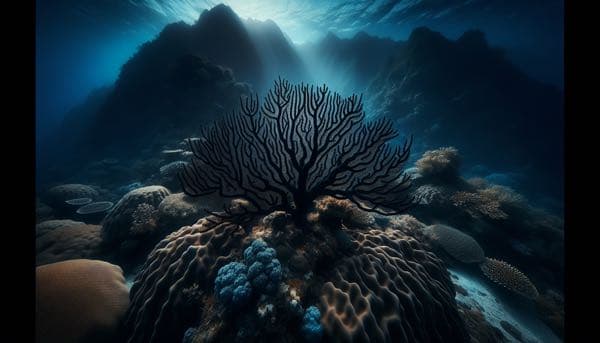
Black Coral (Leiopathes)
Was already ancient when Rome fell. Has watched entire civilizations rise and collapse from the ocean floor without once moving.
Was already ancient when Rome fell. Has watched entire civilizations rise and collapse from the ocean floor without once moving.
Lifespan
4265 years
Your age
20
Height
often several meters in height
Habitat
Deep ocean habitats worldwide
Are you older than a Black Coral (Leiopathes)?
No — a Black Coral (Leiopathes) can live up to 4265 years. You have 4245 years to go.
At your age (20), a Black Coral (Leiopathes) has already established a robust colony (at age 10), but hasn't yet reaches structural maturity (at age 100).
In 2006, when you were born
Population
87,000
Still alive today
85,276
Population trend
📉 Decreasing
Current population
100,000
Conservation status
Data DeficientBlack Coral (Leiopathes) Life Timeline
The black coral, a marvel of the deep ocean, is not your average sea creature. With a lifespan that stretches over 4,000 years, this colonial invertebrate has been around longer than most civilizations. Imagine a coral that has witnessed the rise and fall of empires while slowly branching out in the dark depths of the ocean. Its intricate skeletons not only serve as homes for various marine life but also tell tales of the ocean's secrets, making them the wise old sages of the sea.
Read more
Black corals thrive in deep ocean habitats, where sunlight is but a distant memory. Their slow growth rate—just a few millimeters per year—means they take their time to build those elaborate structures. As they age, these corals become home to a variety of marine creatures, contributing to the biodiversity of their environment. While they may seem stationary, they play a crucial role in the ecosystem, providing shelter and habitat for fish and invertebrates alike. So, the next time you think about ancient beings, remember that some of the oldest living organisms are quietly thriving beneath the waves, far from the spotlight.
Humans have long been fascinated by black corals, often using their skeletons in jewelry and ornaments. However, their slow growth and vulnerability to climate change and ocean acidification have raised concerns about their future. As we continue to explore the depths of our oceans, understanding and protecting these ancient corals is vital—not just for their sake, but for the health of our marine ecosystems as a whole. Who knew that while we were busy inventing the wheel, these corals were just chilling in the ocean, growing and living their best lives?
Started life as a tiny polyp
The black coral begins its life as a minuscule polyp, a single cell that will eventually develop into a sprawling colony. It’s like a newborn human, but instead of crying, it’s busy attaching itself to a rocky substrate.
A black coral (leiopathes) starts life as a tiny polyp at just 0 months old. At that age, most humans are a newborn. Are you older than a black coral (leiopathes) when it starts life as a tiny polyp?
And they're off! The black coral (leiopathes) comes out of the gate — started life as a tiny polyp. The human at 0 months? Can't even hold their own head up. Not even close.
Began forming a colony
After a year, the polyp starts cloning itself, creating a colony that will grow over the centuries. It’s like a toddler throwing a tantrum for more playmates, but in coral form.
A black coral (leiopathes) reaches its began forming a colony stage by age 1. At that age, most humans are a wobbly toddler. Are you older than a black coral (leiopathes) when it reaches its began forming a colony stage?
And they're off! The black coral (leiopathes) comes out of the gate — began forming a colony. The human at age 1? Is a wobbly toddler still figuring out walking. Not even close.
Established a robust colony
By the age of ten, the colony has grown significantly, with numerous polyps working together to build the skeleton. Think of it as a group project where everyone is actually pulling their weight.
A black coral (leiopathes) establishes a robust colony by age 10. At that age, most humans are a pre-teen. Are you older than a black coral (leiopathes) when it establishes a robust colony?
Right out of the starting blocks, the black coral (leiopathes) takes the early lead: established a robust colony. The human at age 10 is a pre-teen begging for a phone and staying up too late. This race is already getting interesting.
Reaches structural maturity
At 100 years, the black coral has developed a complex structure, providing habitat for various marine species. It’s like reaching adulthood, but instead of a job, it’s just a lot of fish hanging out.
A black coral (leiopathes) reaches structural maturity by age 100. At that age, most humans are the oldest human ever. Are you older than a black coral (leiopathes) when it reaches structural maturity?
And they're off! The black coral (leiopathes) comes out of the gate — reaches structural maturity. The human at age 100? Has outlived almost everyone — only Jeanne Calment made it to 122. Not even close.
Hosts diverse marine life
By 500 years, the black coral has become a bustling community hub for marine life. It’s like a senior citizen’s home, but instead of bingo, it’s all about fish and invertebrates.
A black coral (leiopathes) reaches its hosts diverse marine life stage by age 500. At that age, most humans are in Methuselah territory. Are you older than a black coral (leiopathes) when it reaches its hosts diverse marine life stage?
Hosts diverse marine life for the black coral (leiopathes)! At age 500, the human is biblical fiction. Even Methuselah only claimed 969 years. We're off the map. The black coral (leiopathes) doesn't even have competition anymore.
Becomes an ancient structure
After a millennium, the black coral stands as a testament to resilience, weathering storms and currents. It’s like being a grandparent who’s seen it all and still stands strong.
A black coral (leiopathes) becomes an ancient structure by age 1000. At that age, most humans are older than civilization. Are you older than a black coral (leiopathes) when it becomes an ancient structure?
The black coral (leiopathes) is cruising: becomes an ancient structure. A human at age 1000? Methuselah is in the rearview mirror. The Roman Empire is ancient history. We're in deep time now. The black coral (leiopathes) is in a league of its own.
Influences ocean biodiversity
At 2000 years, the black coral has significantly influenced the biodiversity of its habitat, supporting countless species. It’s like a wise elder imparting knowledge to the younger generation.
A black coral (leiopathes) reaches its influences ocean biodiversity stage by age 2000. At that age, most humans are older than civilization. Are you older than a black coral (leiopathes) when it reaches its influences ocean biodiversity stage?
Influences ocean biodiversity — the black coral (leiopathes) is in its prime. The Roman Empire rose and fell during this lifespan. Julius Caesar is a footnote at this timescale. This is the black coral (leiopathes)'s race and the black coral (leiopathes)'s alone.
Reaches maximum lifespan
At 4265 years, the black coral has reached its maximum lifespan. It’s like the wise old sage of the ocean, having seen everything and still standing tall.
A black coral (leiopathes) reaches maximum lifespan by age 4265. At that age, most humans are older than civilization. Are you older than a black coral (leiopathes) when it reaches maximum lifespan?
Reaches maximum lifespan. At age 4265, the black coral (leiopathes)'s race is finally complete. Human civilization as we know it was still in beta. Agriculture was the hot new technology. Humans don't even have a lane at this distance.
Generations of marine life flourish
By age 5000, a black coral (leiopathes)'s lineage has produced grandchildren. With a generation time of about 4000 years, that's roughly 1 generations — several of descendants carrying on the family legacy.
A black coral (leiopathes) reaches its generations of marine life flourish stage by age 5000. At that age, most humans are older than recorded history. Are you older than a black coral (leiopathes) when it reaches its generations of marine life flourish stage?
Generations of marine life flourish at age 5000. Human civilization as we know it was still in beta. Agriculture was the hot new technology. The black coral (leiopathes)'s lineage stretches across timescales that make human history look like a blip.
Impact on ocean health recognized
By age 6000, a black coral (leiopathes)'s lineage has produced grandchildren. With a generation time of about 4000 years, that's roughly 1 generations — several of descendants carrying on the family legacy.
A black coral (leiopathes) reaches its impact on ocean health recognized stage by age 6000. At that age, most humans are older than recorded history. Are you older than a black coral (leiopathes) when it reaches its impact on ocean health recognized stage?
Impact on ocean health recognized at age 6000. Humans were still hunter-gatherers figuring out farming. Writing hadn't been invented yet. The black coral (leiopathes)'s lineage stretches across timescales that make human history look like a blip.
A symbol of resilience
By age 7000, a black coral (leiopathes)'s lineage has produced grandchildren. With a generation time of about 4000 years, that's roughly 1 generations — several of descendants carrying on the family legacy.
A black coral (leiopathes) reaches its symbol of resilience stage by age 7000. At that age, most humans are older than recorded history. Are you older than a black coral (leiopathes) when it reaches its symbol of resilience stage?
Long past any human finish line: a symbol of resilience at age 7000. Humans were still hunter-gatherers figuring out farming. Writing hadn't been invented yet. The black coral (leiopathes)'s legacy is measured in eras, not years.
Lifespan Comparison
This species can live 53× longer than a human.
A Black Coral (Leiopathes) can live to 4265 — you have 4245 years to go.
See what else you're older than